What you can see
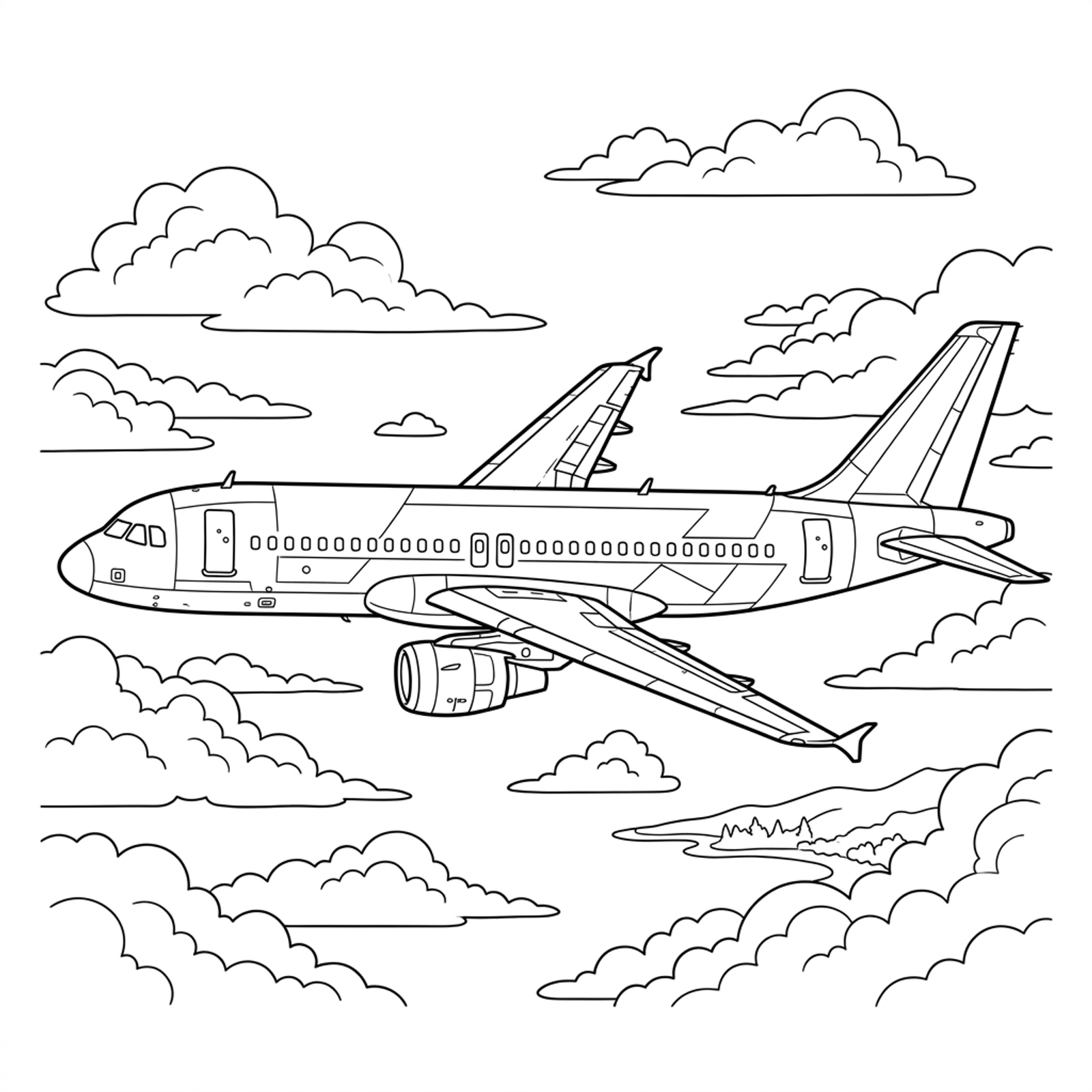
The plane appears from the side, slightly turned, with a long fuselage, a long line of windows, doors and two large wings with an engine under each. The tail has a vertical fin and a horizontal stabilizer. Around it, clouds with wavy outlines form layers and leave gaps of open sky, which gives you lots of room to play with blue.
Ages it is aimed at
It goes well from ten to fourteen. The windows are small but repetitive, and the clouds provide generous spaces for resting your hand. It is an especially rewarding page for anyone starting to practice sky gradients, because the cloud outlines guide the pencil.
How to print the airplane
Download the PDF for your paper and keep the scale at one hundred percent. If you plan to color a rich sky, choose medium or heavy paper and test the blue on the margin first. Normal quality is enough for these clean lines.
Ideas to make it take off
Invent an airline: pick two colors for the tail and wingtips and repeat them in a stripe along the fuselage. For the sky, try a gradient from blue to orange, as if the plane were flying at sunset. Clouds look more real with very soft bluish-gray shadows along their undersides.
Painting light between the clouds
The plane travels through layers of clouds, which lets you build an atmosphere with several distances. Color nearby clouds with stronger whites and grays, and distant ones with very soft blues and violets, using almost no pressure. Near the horizon, a touch of yellow or pink hints at sunset. With a sky built in layers, the jet seems to hang in the air instead of sitting on top of a sheet of paper. When the clouds are done, add one soft shadow under each wing so the jet feels as if it is truly crossing that sky and not hovering in front of it.