Mechanical engineering of Space exploration rocket
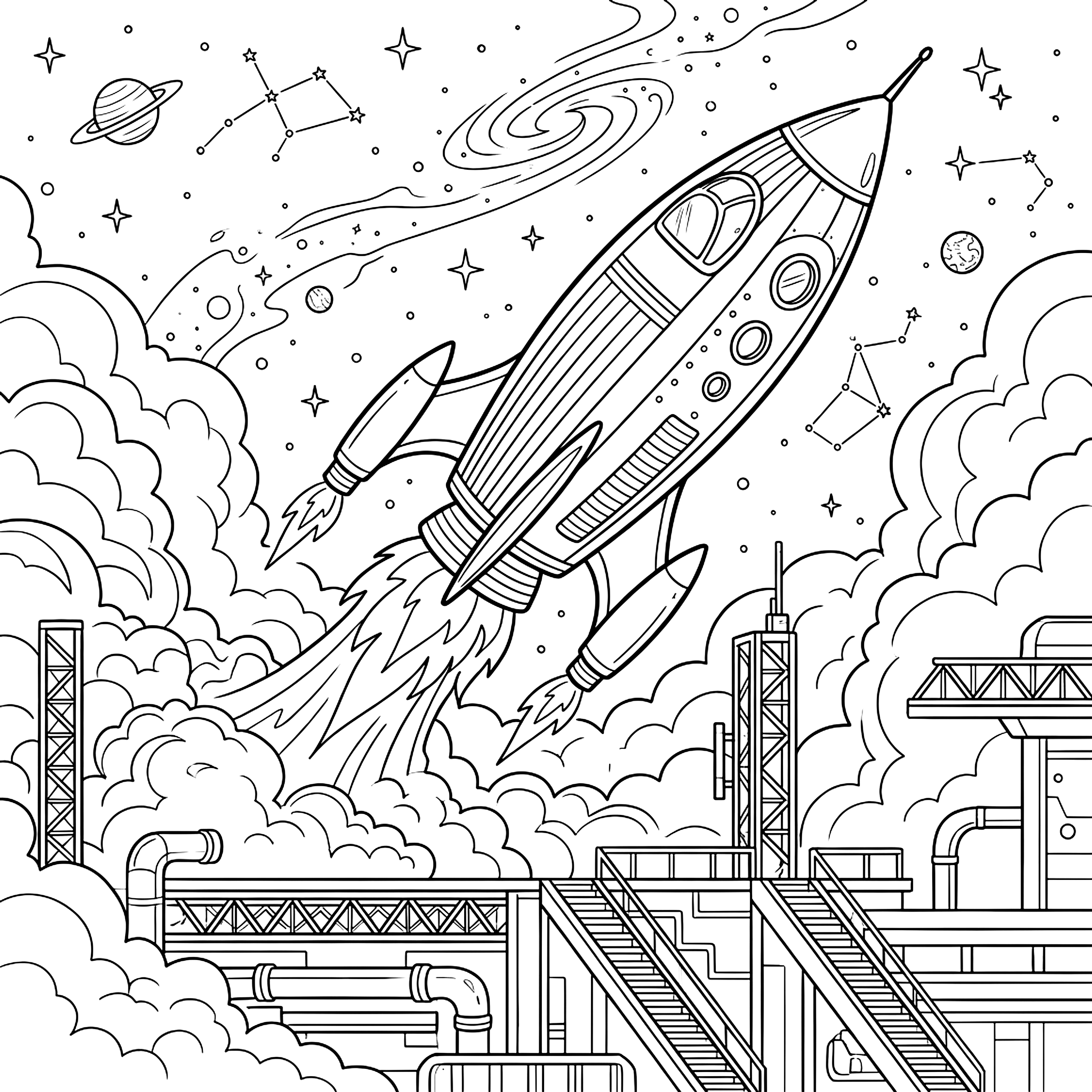
This dynamic composition captures the exhilarating energy of a multi-stage orbital launch vehicle thundering toward the celestial void. The primary propulsion stage features intricately drafted bell-shaped rocket nozzles projecting blazing exhaust plumes and billowing aerodynamic vapor clouds. Across the sleek cylindrical fuselage, technicians can appreciate delineated service hatches, thermal insulation tile textures, and angled stabilizing fins. Crowned by the aerodynamic crew capsule and launch escape tower, the spacecraft rises against an expansive orbital background displaying distant stellar clusters and planetary horizons. Thermal protection silica tiles line the orbital heat shield, designed to survive staggering temperatures exceeding one thousand degrees Celsius during searing atmospheric reentry. Heavy gimbal actuators pivot the massive engine bells continuously to maintain precise directional trajectory through the upper stratosphere.
Recommended age range for Space exploration rocket
Tailored for young aerospace and astronomy enthusiasts aged ten through fourteen. The long cylindrical hull contours paired with billowing launch flames provide a wonderful playground for mastering curved light falloff and fiery gradients.
Printable PDF download for Space exploration rocket
Our downloadable vector PDF file of this orbital exploration rocket is formatted for standard Letter and A4 domestic printers. Crisp vector geometry guarantees laser-sharp details for astronomy lovers and prospective aerospace engineers.
Coloring tips for Space exploration rocket
Ignite your palette by pouring brilliant canary yellow directly into the core blast of the exhaust nozzles, gradually blending outward into fiery tangerine and deep crimson along turbulent plume edges. Keep the rocket fuselage predominantly pristine white while applying cool cerulean or dove grey shading along one curved flank to establish volumetric cylindrical depth. Wash the surrounding cosmos in rich layers of midnight indigo, royal purple, and deep navy, preserving uncolored white dots for distant glittering stars. Stippling white gouache dots inside the combustion exhaust enhances incandescent brightness. A striking illustrative accent involves painting the planetary curved limb in luminous neon cyan while swirling faint white atmospheric vortices to represent storm systems drifting over oceans. Shading the booster exhaust core with bright lemon yellow creates an intense incandescent blast effect.
History and technical heritage of Space exploration rocket
Modern space exploration relies upon Isaac Newton’s third law of motion: by expelling burning gas downward at supersonic speeds, the rocket experiences an equal and opposite thrust propelling it upward into orbit. Multistage rocketry enabled humanity to land on the Moon and establish orbital satellite constellations that connect our global telecommunications in real time.