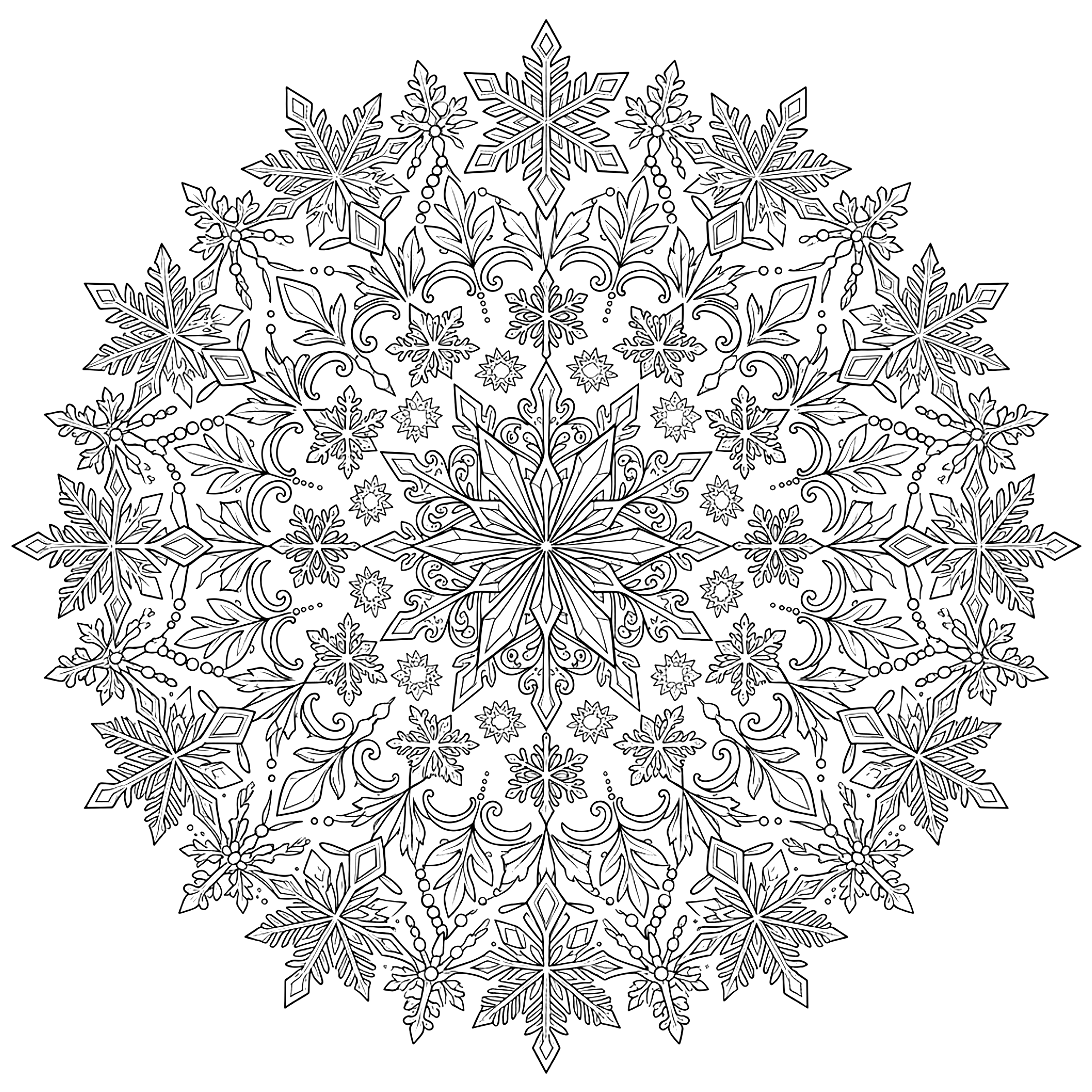
Geometric symmetry and details of hexagonal ice snowflake crystals
Anchored by a prominent six-armed central frost rosette, the mandala unfolds outward with dendritic crystal needles, faceted ice prisms, and delicate frozen filigree borders. Each repeating concentric ring mirrors the molecular crystallization of water vapor, providing harmonious segments for delicate blue and silver shading. Exact sixty-degree angles repeat faithfully across every concentric tier of crystal branching, establishing a silent visual peace like fresh morning snowfall. Delicate ice lace patterns connect the secondary crystal star points with crystalline poise.
Recommended age range for hexagonal ice snowflake crystals
Perfect for children aged eight through fifteen, teenagers, and adult colorists enchanted by winter landscapes. Working across sixfold radial symmetry naturally soothes mental fatigue and improves steady hand-eye control through delicate line following.
Printer setup for crisp hexagonal ice snowflake crystals mandala linework
Download and print this vector PDF at actual size on Letter or A4 drawing paper without scaling down margins. Heavyweight white stock of at least one hundred twenty grams ensures watercolor pencils or dual-tip brush pens do not bleed through.
Coloring techniques and palette for hexagonal ice snowflake crystals
Blend cool glacial tones including pale ice cyan, periwinkle blue, arctic turquoise, and cobalt. Preserve uncolored paper highlights on the sharp crystal ridges, and wash a soft slate blue background in the outer border to make frost needles gleam brilliantly. To achieve a frosty crystalline shimmer, wash pale turquoise across background wedges and dab with a kneaded eraser to lift clean polar light accents. Stippling silver gel pen dots along crystal tips gives the illusion of freshly fallen powdered frost.
Cultural history and meditative wisdom behind hexagonal ice snowflake crystals
Pioneering nineteenth-century photographer Wilson Bentley captured thousands of individual natural snowflakes through his microscope camera, proving that while no two snowflakes are ever completely identical, all faithfully obey sixfold molecular geometry.